
Home Lyrics Musicians Albums History Interviews Links
1978 - 1989
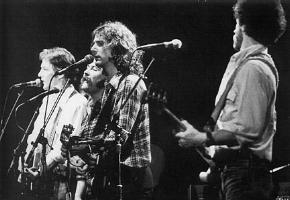
| In late 1978 Roger McGuinn and Gene Clark toured the States doing small club gigs (picture right). In December they were joined by Chris Hillman and also by David Crosby when performing at San Francisco's Boarding House (picture below). Unfortunately they didn't envite Crosby to join them on their new project which led to the recording of "McGuinn, Clark & Hillman" on Capitol Records in 1979. After touring through Europe Gene Clark showed the same problems again with staying sober and reliable like in 1968 when he had attempted to reunite with the Crosby-less Byrds. | 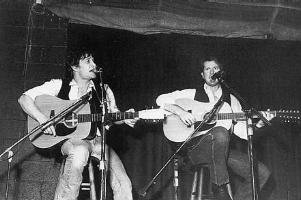 |
 |
The group's second excellent album "City"
was recorded mainly without Clark, except some strong contributions he had
managed to record. McGuinn and Hillman, disillusioned by playing
low-key gigs, called it a day and departed again. After their last album "McGuinn-Hillman"
both decided to quit the race for good. In 1981 Chris Hillman got together with old friends Leadon, Perkins and Herb Pedersen to record the bluegrass album "Morning Sky" in 1982 and teamed up again with Rick Roberts for a short tour. He recorded another traditional country album, "Desert Rose" in 1984 and collaborated with Leadon and Perkins on projects entitled Down Home Praise and Ever Call Ready, which resulted in 2 albums of Christian bluegrass. |
In the mid-Eighties Hillman formed a new group, the Desert Rose Band, with country talents Herb Pedersen, Jay Dee Maness, John Jorgenson, Bill Bryson and Steve Duncan and recorded successful albums "The Desert Rose Band" (1987) "Running" (1988) and some more. The band was tipped for Grammy awards and topped the country charts. |
| In the early Eighties Gene Clark
briefly teamed up with Hillman, Perkins, Pedersen and Clarke to record
some demos with Jim Dickson but unfortunately the experiment was
discontinued. In 1984 he recorded "Firebyrd"
with the help of Hillman, an album including Byrds originals which led to
his idea to perform as the "20th Anniversary Tribute To The Byrds"
with Michael Clarke, John York, Rick Roberts, Rick Danko, Richard Manuel
and others. When the tour reached England the group was announced simply
as "The Byrds". In different line-ups they continued performing and
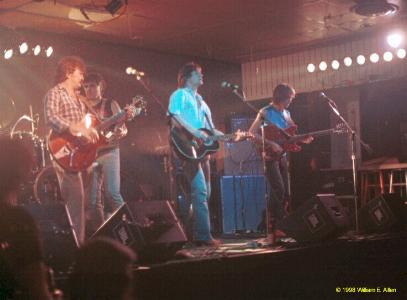
recording as "CRY" (Clark, Robinson,
York) (right picture). (For more information about yesterday's and today's CRY click HERE ) |
 |
In 1987 Clark recorded "So Rebellious A Lover" with Carla Olson and recorded new compositions and Byrds classics on home studio base with Patrick Gerald Robinson sometimes assisted by Jesse Ed Davis. He continued to lapse into drink and drug abuse and had to undergo a serious stomach operation. In 1988 he stopped touring under the Byrds'name (while Michael Clarke continued) and did more recordings with Robinson. In 1989 McGuinn, Crosby and Hillman played three California dates to secure their claim to the Byrds' name in competition to Michael Clarke's changelings. Clark, who was ready to reunite with his former colleagues, was dissapontingly not envited to join them on stage. Roger
McGuinn avoided the trap of attempting to form another major label
superstar aggregation and reverted to his coffee house troubadour persona
of the early Sixties. Since his re-conversion to Christianity he
avoided to reunite with his former associates and continued as a solo act.
The closest McGuinn came to fraternizing with ex-Byrds during the early
Eighties was a tour with the Peaceseekers, whose line-up featured Gene
Parsons, Skip Battin, Greg Harris and Jim Goodall in 1984. Since then
McGuinn has often toured the States and Europe with his wife Camilla,
appearing in small clubs and halls, performing a selection of past hits
and some new songs. David Crosby in the Eighties fell victim to
cocaine addiction on a grand scale. In 1981 Capitol rejected Crosby's
second album, maintaining it was musically anachronistic and he was
threatened to go the way of McGuinn, Clark and Hillman. Starved of a major
record label, there was nothing else to do but survive by playing small
club dates. |
| While the all-consuming addiction robbed him of
every concentration and vitality, he made several unsuccessful attempts to
get rid of his drug problems and got news nationwide for beeing arrested
because of drug abuse and owning illegal weapons more than once. In
1985 he turned himself in at a FBI office in Florida and was arrested in
Huntsville Prison where he got a job in the prison mattress factory. In
prison he slowly adapted to life behind bars and even began writing new
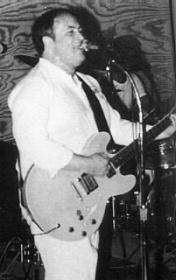
songs, as well as appearing in the prison band (picture right). On 8 August 1986 Crosby was freed, emerged from custody overweight, drug free and reformed. In 1987 he was back in the studio with Stills, Nash and Young, recording the album "American Dream" (released 1988). He married Jan Dance on 16 May 1987. Among the guests were McGuinn and Hillman. His second solo album "Oh Yes I Can" at last was completed and released in 1989. The most successful Byrd in the Seventies had beeen Michael Clarke with supergroup Firefall. In the early Eighties he left the band, which rapidly plunged downhill. For several years he worked with Jerry Jeff Walker, then joined Clark's "Byrds" tour and finally tried to establish himself as an impresionistic painter, reitiring for almost three years. In 1988 he returned and decided to revive the Byrds' name. |
 |
Thanks Johnny Rogan for some excerpts on this page
from his fantastic book "Timeless Flight Revisited"
(Published at Rogan House, 1997)
The Beginning 1964
1965
1966
1967
1968
1969
1970 - 1972
1973 - 1977
1978 - 1989
1990 - 2002